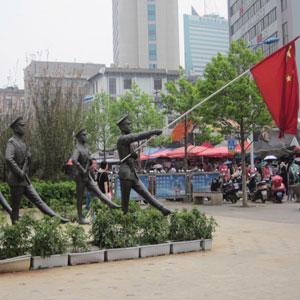
Travel essay on China, Khabar, January 2013

Travel essay, China, Khabar, January 2013
Source: http://www.khabar.com/magazine/features/travel_vignettes_from_china


Travel: Vignettes from China

Travelers to India and China alike will detect a palpable buzz in the air... of good times, great jobs, free-flowing wealth, general optimism and bonhomie. Shopping malls, luxury brands, and flashy new cars signal changing times in India, but on a much larger scale in China.
A huge billboard outside the international airport in Kunming, Yunnan Province, greets travelers as they enter and exit the airport. It sports a quote from Warren Buffett. His name is spelled out in English, but the actual quote is in Mandarin. Surely, this can’t be a quote by Buffett extolling communism, I think to myself. Nobody quotes Buffett on communism or the ills of capitalism. Even I, with my truncated knowledge of stocks and shares could tell you that Mr. Buffett is exhorting you to make money, albeit in Mandarin. That’s “socialism with Chinese characteristics”— a phrase you hear quite often in China.
I was in China for two weeks, to participate in two training workshops offered by my employer to their Chinese counterparts. Having traveled mostly within the Romance language parts of the world, I knew that the only thing that I could do to prepare for my trip was to arm myself with inane factoids about China such as this one: did you know that three out of four tall building cranes in the world can be found in China? It felt like I must have encountered all but one of those cranes during my travels in China. Try this other factoid on for size: the Chinese communist party anointed a small town in the southwestern Yunnan Province as Shangri-La? Yes, Joseph Hilton’s fictional Shangri-La is now an actual Chinese town. Or this: the largest peaceful migration of humans in modern times occurs when over 300 million Chinese workers hop on trains to visit their hometowns during the Chinese New Year holidays. Imagine if the entire population of the United States were to pack their bags and head off to various destinations. And this: a city in China is considered mid-sized if its population is only around 5 million.
I look back on my two weeks in China and search vainly for one word to capture my impressions. The words I find are all prefixed with “awe”—awe-inspiring, awestruck, and with a little stretch, awe-ful (and awe-mazing). My mind’s eye is peppered with images of broad highways snaking through anonymous exurbia peppered with gleaming new skyscrapers, and cranes stretching far into the horizon.
For two weeks, I visited Nanjing (the erstwhile Nanking), Shanghai and Kunming. I learned and unlearned many things about its peoples, its culture, and its cuisine. As an Indian living in the United States and visiting China for the first time, I was weighed down by the self-imposed burden of having to make insightful commentary and observations on comparative socio-political economics. I know now that you can’t explain China in pithy one-liners just as you can’t explain India or even the United States.
Travelers to India and China alike will detect a palpable buzz in the air-of good times, great jobs, free-flowing wealth, general optimism and bonhomie. Shopping malls, luxury brands, and flashy new cars signal changing times in India, but on a much larger scale in China.


Book Review, Muse India, September 2012

Book Review: India, A Traveller's Literary Companion
Originally appeared in the Sep-Oct 2012 issue of Muse India
Source: http://www.museindia.com/regularcontent.asp?issid=45&id=3640


Girija Sankar : India - A Traveller’s Literary Companion

A diverse picture of the geography and culture

India is complex. It is befuddling, beautiful, harsh and confusing. India is a catch-22, a conundrum, a story within a story within a story. One billion people, 26 official languages, 2000 dialects, and almost all major world religions represented. This diversity and the fact that in spite of it, the country continues to amble along, and even show robust economic growth over the last couple of decades has continued to amaze the cognoscenti and the hoi polloi alike. An interesting characteristic that shapes this diversity is that the states in India are for the most part linguistically divided, with many of the states having a distinct language, script and several dialects of their own. In this regard, the Indian federation is more like the European Union than the United States.
It is perhaps their long familiarity with this situation that has allowed Indians in India to become adept at navigating differences. Hop on the Andaman Express in Kanyakumari today and find yourself traversing 277 train stations between Chennai and New Delhi, reading station signs in at least six different regional languages, and eating everything from sambar idlis to Hyderabadi biryani to aloo parathas, all in a span of a mere 56 hours.
A multitude of languages unfortunately does not lend itself to an easy understanding and appreciation of the rich vernacular prose and literature from different states. The beauty of truly knowing a language well is that it provides a vehicle to understand the music, the literature and the culture of the people who speak it. In India’s case, one cannot possibly be expected to master all of its many languages sufficiently to be able to take a deeper dive into the literature, folktales and stories of each of these states with linguistically defined cultures. It is to fill this breach, comes a delightful collection of stories in India - A Traveller’s Literary Companion.
Stories are organized in five sections, each pertaining to a geographically defined region in India - East, West, North, South and North East with stories from various states falling within each section. With around thirteen stories, the collection paints a diverse picture of the geography and culture of India. A few of the stories were written in English originally but most others have been translated from the vernacular. The book begins with a story set in Kashmir by Salman Rushdie and ends with one from Tamil Nadu, essentially covering the length and breadth of the country. Rushdie’s story, “The Prophet's Hair,” is a great start to the collection and is, based loosely on a true incident - the theft of a relic from a mosque in Kashmir. Using his signature style of magical realism, Rushdie weaves a tale that at once combines fact with myth and legend.
The collection is notable for its lack of a unifying theme. This choice is a conscious one on the part of Chandrahas Choudhury, the editor. It would seem that he has chosen not to create a forced sense of unity but rather let the different contexts, backgrounds, and literary instincts of the authors speak for themselves. In “The Accountant,” Kunal Basu imagines the world of the Taj Mahal just before and during the time of its construction by allowing the protagonist to go back in time to an earlier lifetime. An accountant with a passion for history thus becomes the Chotta Mimar, a young Persian architect who is part of the team designing the Taj at the Emperors’ behest.
Goa boasts a different kind of entry in the collection with Anjum Hasan’s “Eye in the Sky,” where Dawn, a young married middle class Indian woman, tired from the tedium of her marital life, feels a deep desire to just get away. She does just that one day, on a whim, after a spat with her husband. She hops on a bus to Goa. Through vivid descriptions of the beach resort culture in Goa and the conversations of foreign and domestic tourists, the story also manages to convey the challenges to a young woman traveling solo in India.
The highs and lows of ordinary life, the effect of place on one’s circumstances, human foibles and aspirations are all exquisitely brought together in the different stories. While a small collection cannot be expected to capture all the nuances and flavors of a region in its entirety, it does provide a window into a world which is normally denied to most people unfamiliar with a language and consequently the cultural nuances and subtleties. Though labeled a "travel essay," the book deserves characterization as a literary anthology. A delightful read promising the reader perhaps a more nuanced understanding of what makes India – India! 


Book Review, India Currents, August 2012

Source: http://www.indiacurrents.com/articles/2012/08/12/promise-happiness

The Promise of Happiness, Girija Sankar

BEAUTIFUL THING: Into the Secret World of Bombay’s Dance Bars. By Sonia Faleiro. 240 pages. Black Cat, (US edition) 2012, $15.00.

In the non-fiction Beautiful Thing, Sonia Faleiro offers up a rare and fascinating account of Bombay’s dance bars through a raw, honest and, at times, heart wrenching story of Leela, the protagonist who is a bar dancer. Faleiro follows the life of Leela and a cast of characters from Leela’s family, her dancer friends, lovers, clients, dalals (pimps), and hijras (eunuchs).

The author, a journalist, spent five years researching the murky world of dance bars. 
In Bombay’s dance bars young females dance to the latest Bollywood item numbers, offer drinks and one-night-stands to men from all walks of life: the underworld don, the hit man, the poor college student out to charm his first love and the middle aged pot-bellied salaried husband out for a night away from wife, home, and creditors. Bar dancers like Leela often come from small town India, searching for a way out of poverty, abuse or just a sheer need for survival. Some are taken in by brothel madams who, Faleiro recounts, often scope out bus stands and train stations for seemingly hapless girls from far away villages. Some of these women, often illiterate, find themselves working in dance bars if they are lucky or ending up in brothels.
This tale unfolds with Leela fleeing her tiny home town at the tender age of 13 to escape sexual abuse from her father’s cop buddies. Her mother, a mute spectator to her father’s shenanigans, also suffers violent abuse. But Leela, displaying remarkable maturity at her young age realizes that her fate would be no better than her mother’s were she to stay in the village. So she flees. After working at a brothel for a few months, Leela finds herself at a dance bar. Not conventionally beautiful, Leela manages to catch the eye of Shetty, the bar owner, and begins a relationship with him.
Faleiro takes pains to explain that while dance bars do not explicity promote prostitution or sex work, dancers often end up finding steady “clients” among the men who frequent the bars. But Leela claims to have never done this galat kaam (sex work), when in fact she often has. In the murky hierarchy of the sex industry, the street walkers or the floating sex workers occupy the lowest rung, followed by brothel workers, followed by call girls—women who claim to be college graduates from respectable families. Bar dancers are at the highest echelon in this hierarchy, and as Leela states “When some people saw Leela, they saw a dhandhewali, working girl. But when she saw herself-in the mirror that hung behind her bedroom door ... she saw a bar dancer.”
Faleiro describes the silent bars, where men order not just a drink but also the female waiter who brings it to them. To Leela, who claims never to have participated in galat kaam, the silent bar workers are as low in the pecking order as the street walkers. But, bar dancers do not have to sell sex. That they do so is purely incidental.
The prose is free-flowing and often poetic. Faleiro hooks the reader in early on when she writes, “When they took her virginity from her, cursing that she’d knotted the drawstring of her salwar like it was a sack of atta she was saving for winter, all she saw were the peepal trees of the [police] station compound. Their leaves were crowded together ... to gossip and wonder at her shame.”
When we get to know Leela she is at the pinnacle of her career—clients showering her with gifts, her pockets literally overrun with cash (she even stashes some inside shoes) and a steady partner. But then things begin to unravel. Dance bars in Bombay are coming under increasing scrutiny and the state begins shutting them down. Shetty, her partner moves on.
Leela, like the many hundreds of women who have been suddenly left without a job, tries out other things before she and her friend find a benefactor from Dubai who promises luxuries, wealth and much happiness if the women would dance at Dubai’s night clubs.
Faleiro never hears from Leela again. What will happen to her we wonder. Will she make it big and return home with gold, wealth and much happiness or will she become yet another statistic?
For all the beautiful prose, one minor flaw in the author’s style is the excessive dependence on local accents and argot. Too many Kustomers, dirty-dirty and onomatopoeic references appear jarring to readers unfamiliar with the sub-continental English and Hindi.
Faleiro, whose first book was a novel titled The Girl (2006), has received much accolade for what critics have hailed as amongst the best non-fiction writing to come out of India in recent years. Beautiful Thing is as much a story about Bombay as it is about Leela and as such merits being ranked amongst the best in contemporary literary journalism from India. 

Cover Story, Desi Jazz, Khabar Magazine, August 2012

Cover Story: All that Desi Jazz
Originally appeared in the August 2012 issue of Khabar Magazine
Source: http://www.khabar.com/magazine/cover-story/all_that_desi_jazz

On June 21, 2012, as we went about our daily activities, two Indian-Americans had made it into the annals of American music history, yet again. The Jazz Journalists Association honored Rudresh Mahan- thappa as Alto Saxophonist of the Year, and Vijay Iyer as Pianist of the Year. Mahanthappa won the same award in 2011, 2010, and 2009. In 2010, the Jazz Journalists named Iyer the Musician of the Year. Consider this: Iyer won an award that had been previously bestowed to jazz greats such as Herbie Hancock. Vijay Iyer also won in five categories in the recently announced 2012 Downbeat International Critics poll.
When one thinks of Indian influences in the global music scene, sitar maestro Ravi Shankar comes to mind, and indeed, his influence on Western performers and audiences is well-documented. Jazz great John Coltrane studied under Shankar and even named his son after the maestro. Today, Ravi Coltrane is himself an accomplished saxophonist.
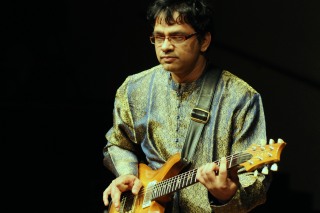
Prasanna_Koln1_049.JPG“Guitar” Prasanna.
Music enthusiasts may also be aware of artists like “Guitar” Prasanna whose explorations of Carnatic music on the guitar have won him much praise and accolades, including stints as a composer for various Tamil films. But also consider this: the contemporary jazz scene in the States today is home to not just Iyer and Mahanthappa, but also, among others, to performers like Sameer Gupta, a noted percussionist who plays the tabla; Sunny Jain, a dhol player/percussionist who started a band that would feature the dhol as the lead instrument; Sachal Vasandani, a jazz vocalist; Rez Abbasi, a Pakistani-American guitarist/composer; and Rafiq Bhatia, an up-and-coming guitar player/composer.
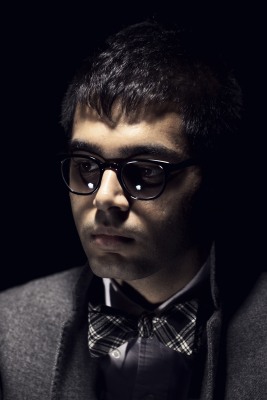
rafiq2_046.JPG

Rafiq Bhatia.
The stories and musical journeys of the various artists profiled here—some of the most talked about desi performers who showcase jazz in their compositions and repertoires—reflect that very quintessential of immigrant experiences, a quest to marry the richness of the native and adopted cultures, whether the artist is a chef marrying diverse tastes or a saxophonist merging Charlie Parker with Kadri Gopalnath.

All what jazz
Rock ‘n’ roll, rock, and hip-hop feature prominently as early influences for artists such as Bhatia. But, as Indian-Americans, many were also exposed to Carnatic music, bhajans, ghazals, and Bollywood numbers, setting the stage perhaps for a greater appreciation of music in general and particular similarities in rhythms and tones. Early evidence of musical talent and precociousness is a common thread in these artists’ youth.
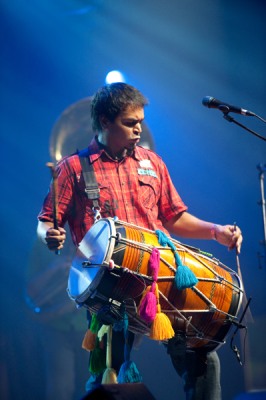
SunnyJain1_044.JPGSunny Jain.
“I grew up with Jain bhajans, Bollywood music, and a heavy dose of classic rock,” says Jain, who leads Red Baraat, a nine-piece dhol and brass band. His drums instructor, himself a bebop jazz drummer, encouraged Jain to join his junior high school’s jazz ensemble. Pretty soon, he was completely taken by jazz and began studying some of the jazz greats. Jain later went on to obtain a B.M. in Jazz Performance from Rutgers University and an M.A. in Music Business from New York University.
When his parents visited India, Bhatia, then a first grader, asked them to bring back a snake charmer’s flute. His precocious talent in music became apparent to his parents when he played the then-popular Hum Aapke Hain Kaun tune on the flute, almost as soon as he heard the soundtrack. Bhatia, the son of East African Indian immigrants, is a guitarist/ composer who enjoyed hip-hop growing up. His interest in jazz developed when he took up guitar in high school and started listening to Jimi Hendrix, Miles Davis, and John Coltrane. Bhatia spurns categorization as an artist. His music may not fit cleanly into what people imagine when they think of jazz. “I make instrumental music that incorporates improvisation and draws on all of the music that inspires me,” he says.
Iyer grew up in a traditional middleclass South Indian-American household. Even though he didn’t start out playing Carnatic music, he was drawn towards it in his twenties. “Carnatic music has a certain symmetry, much like the kolam (South Indian design that adorns the floor in front of homes) or the South Indian temple architecture,” Iyer says.
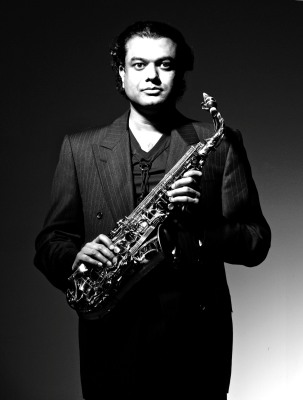
Rudresh3_043.JPGRudresh Mahanthappa.
By contrast, Mahanthappa, who started playing the saxophone in elementary school, was exposed to the occasional bhajan music at home, but not much more. Mahanthappa’s exposure to Indian classical music came from a college trip to India in the early ’90s. “It was a revelation,” Mahanthappa says. Attending traditional music concerts from sunrise to sunset, and being exposed to a whole new genre was eye-opening. And then he heard about Kadri Gopalnath, who had mastered Carnatic music on the saxophone. Something clicked. Soon after, he met Iyer and they began their creative collaborations that spread over many albums and continues to this day.
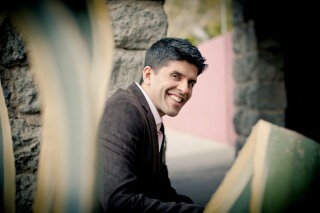
Sachal3_048.JPGSachal Vasandani.
In an introduction to Sachal Vasandani, NPR host Michelle Norris offers, “Every now and again you hear a special voice that makes you sit up and take notice ... Sachal Vasandani has that voice.” Vasandani, a jazz vocalist, drew attention when he won DownBeat magazine’s Collegiate Jazz Vocalist of the Year award in 1999.
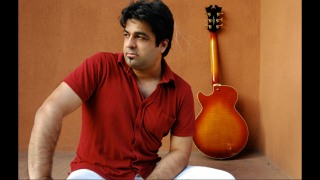
Rez3_051.JPGRez Abbasi.
Rez Abbasi, born in Karachi and raised in Southern California, is an accomplished guitarist and composer who was tutored by Ustad Alla Rakha. Abbasi, who will visit Atlanta in early 2013 for a concert with Georgia State University faculty and organize workshops on jazz and Indian/South Asian classical music, was exposed to Indian classical and film music through television and from relatives singing around the dinner table at family gatherings.
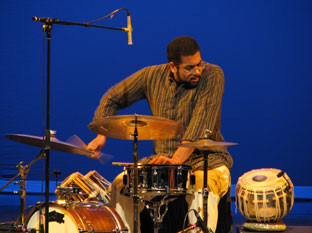
SameerGupta2.jpgSameer Gupta.
Sameer Gupta, a percussionist who plays a hybrid tabla and drumset simultaneously, became curious about jazz in high school and was at first hesitant about the art form. “I also didn’t like things that sounded ‘out’ and didn’t have patience for stuff that rocked the boat too much,” he says. With time, though, a greater appreciation of the music allowed him to embrace “the rocking that ensues when it is truly floating down the stream of consciousness.” Growing up, Gupta was exposed to the popular film and ghazal music from the ’60s and ’70s, but became a serious practitioner only several years after college, where he received a degree in Western Orchestral Percussion.
Prasanna, who attended college in India before moving to America, grew up with the music of Michael Jackson, Tamil composer Ilayaraja, Carnatic musician Lalgudi Jayaraman, and Iron Maiden. Given the broad range of musical interests, “jazz was just a logical extension of my curiosity,” he says. However, it took Coltrane’s record Ole Coltrane for Prasanna to truly understand and appreciate the art form. The record “drove home the point that jazz is much more than fancy chords, complex technique, and virtuosic playing. It’s about personal expression.”