Book Review, Lia's Purpura's Rough Likeness, JMWW Summer 2012

Book Review: Rough Likeness By Lia Purpura
Originally appeared in the Summer 2012 issue of JMWW.
Source: http://jmww.150m.com/PurpuraRev.html


Rough Likeness 
by Lia Purpura
Sarabande Books, 2011
978-1936747030, 224 pp., $15.95 paperback
 
Rough Likeness, Lia Purpura's latest book, is an eclectic collection of essays and an attempt at explaining the mundane, the ordinary, and the things that do not usually populate dinner table conversations but are nevertheless part of the everyday imagination and life. Take the first essay, for instance, on buzzards: Why do we ignore the buzzard, she asks? A bird that does the job nobody else is prepared to do. I haven't killed a thing, the buzzard implores. Why see me as malevolent? "That no one wants my job that I go on being needed." In the essay titled "Against Gunmetal," Purpura laments about why some choose to describe shades of gray as gunmetal or as battleship gray. "Strike me down if I use it again. If I don't, right now, erase this method by which we impart, those of us who know nothing about guns, drama to a sky, pressure to a scene, hardness, knowhow, coldness to a description, glad for its hint of treachery, its sidelong, thanatotic meanness." Laziness in language and expression is something the author abhors, and is a theme that surfaces in other essays as well.
Purpura's prose is at once rich, lyrical, sudden, and provocative. Through her writing, she invites the reader to do what she does—provide everything you do, see, touch, or feel with the uniqueness of observation and attention that it deserves: "Here is a field between parking lots—real grass and dirt with bottles thrown in, amber longnecks, flat clears of hard stuff."
In the essay titled "Jump," Purpura ponders over the intentions behind a signpost that reads "Last Death from Jumping or Diving from Bridge June 15, 1995."
"Around the sign, around the inconclusive or—because of the or, the pause it stirs, the space it opens—fragments and conjectures gather: the last person was drunk"
Her reflective essays then are an essay (pun intended) into the layers folded under and between the everyday occurrences, the random signposts, the street signs, the buzzards flying overhead or the words attributed to colors (why gunmetal for gray?).
Rough Likeness can be savored whole or in bits, read from beginning to end or from the middle backwards. Purpura's writing is such that even without context, the prose is beautiful, to be enjoyed much like a Dali painting, different vantage points allowing for varied appreciation of the artwork.
That the author is also a poet is evident in the lyricisms and incantations in the writing, as when she describes a street as "that echt yellow stripe, those newly dribbled tar snakes filming cracks, curbs darkened with rain, fickle puddles, passing cars launching watery stars out of low spots to firmanents elsewhere."
The brilliance of Purpura's writing is such that even though her subjects in the essays may be ordinary (in the most fundamental sense of the word), in the rendering of the mundane as sublime and as that demanding acute and singular observation, she demands, nay commands the reader's absolute attention.—Girija Sankar

Poor Economics, Book Review, Hunger and Under Nutrition Blog, May 2012

First appeared in the Hunger and Under Nutrition Blog 
Source: http://www.hunger-undernutrition.org/blog/2012/05/book-review-poverty-economics.html
Poverty Economics: A Radical Rethinking of the Way to fight Global Poverty - Abhijit Bannerjee & Esther Duflo,    Public Affairs. 2011.
There has been much debate recently on the efficacy of foreign aid and  whether international NGOs and developed countries ought to invest their tax dollars and grant funds in resource-poor countries.  These are very controversial issues and much that has been written both in academic and popular publications.

This book is not about any of them.

Poverty Economics: A radical rethinking of the way to fight global poverty by Abhijit Banerjee and Esther Duflo looks at the question of micro-approaches to poverty eradication, i.e. small scale interventions through local policy making or small but significant technological changes.  It avoids grand generalizations about “poor people” and tries to explain their challenges in context.  It also points out how in many cases, the basic choices that the poor have to make are already made for the rich.

The authors are both professors, economists and the co-founders of the Poverty Action Lab at MIT.  Through a number of field studies and using their favorite research method- Randomized Controlled Trials - the authors demonstrate that it is possible to have a significant and meaningful impact on the lives of the poor through context specific micro-changes. The book provides numeous examples from the fields of healthcare, education,micro-lending/saving, economic development and nutrition security, all in the context of the lives of people who make less than $1  per day.

The first part of the book focuses on the private lives of the poor and their approach to healthcare, education, and savings.  The second part discusses the efforts of institutions - large and small - in impacting the poor in meaningful ways.  Banerjee and Duflo also demonstrate how many big interventions fail because they often ignore or neglect local aspirations, cultures and contexts.   The real value of this book is that in case after case, the authors provide tools and techniques for understanding the performance of various interventions that have been implemented. Mainly, they rely on creative problem solving in the local context and the use of rigorous statistical methods to evaluate how indicators such as school attendance or healthcare availability have improved as a result of a new approach to problem solving.

In short, this book is a must-read for development practitioners working in the field of poverty alleviation and seeking new ways of approaching program and policy impact.

http://www.amazon.com/Poor-Economics-Radical-Rethinking-Poverty/dp/1586487981

On kid-friendly online news sources, India Currents, April 2012

Originally appeared in the April 2012 issue of India Currents
Source: http://www.indiacurrents.com/articles/2012/04/13/dont-just-google-it


Don’t Just Google It!

The teenage girl in the ABC sitcom The Middle asks her mother (played by Patricia Heaton ofEverybody Loves Raymond fame) where she could learn about love, seeing as Valentine’s Day was around the corner. The mother, exasperated and annoyed, dismisses the girl with a “Just google it,” then takes a moment’s pause and says, “May be not…don’t google it.” Where then do young adults and children go online to learn about love, the Arab Spring or the economic crisis? Where can parents go online to steer their children towards accessible, safe and reliable information?

Deepa Gopal, the founder and visionary behind U.S Based Youngzine started the website as a way to bring world affairs to the attention of her young son who had outgrown kiddie websites like Disney but was still not mature enough to get on Wikipedia. “Most mainstream media assumes some level of understanding. So, when we did not find any [websites] that fit the bill, we decided to start one!” Sites like National Geographic Kids, while very resourceful for general knowledge, may not provide much kid friendly content on current, international and political affairs. Deepa often found herself “tailoring content for [her son’s] schools assignments.” Barkha Madan, of Our Little Earth had similar motivations. She found herself culling stories from the Internet and tweaking them just so her nieces could read about the world in accessible and easy-to-understand language. The website and e-newspaper was born when Barkha’s edited stories were being forwarded to friends and family. Meera Dolasia'sDOGOnews (dogo means young or small in Swahili) was a response to the amount of research that her then second grader’s weekly homework assignments required on a daily basis. Why not start a website that does just that, Meera thought. And so, DOGOnews was born.
Deepa’s passion was so strong that she quit her full-time job at Cisco after a 17 year-long career in computer hardware. With much technical and intellectual support from Deepa’s husband, Youngzine went live September 2010. Meera’s engineering background helped her set up Our Little Earth but with additional support from developers. DOGOnews had a modest start as a regular email update with PDF attachments which later led to a blog and then six months later, a fully-featured website.
When sourcing articles for the websites the writers start their research online on mainstream news, politics, science and technology. “I continuously scour the web for interesting content that could be intriguing, educational and appropriate for my young audiences,” says Meera. Youngzine’s Deepa tries to reach beyond mere expository text to explain the socio-political and cultural context that shapes the world’s news. This angle enables teachers to foster critical thinking amongst students. For instance, a recent article on the Arab Spring described not just the events but also the historical and political context surrounding the events in simple and crisp language. Deepa is quick to point out that in selecting topics, “avoid sensational articles that take center stage in mainstream media as there really is no value in those for children.”
Our Little Earth covers ten main stories each month and like Youngzine, “has a bias towards stories that provides an opportunity to talk about the rich historical and cultural backdrop on the region being covered.” The audiences for all three websites are children and young teens in the 9-14 age groups, school teachers and ESL learners. Studies show that the biggest drop off in academics happens in the middle school years, says Deepa, so the websites finds a way to sustain interest in that crucial age-group.
The websites are being increasingly sought after by schools, both within the US and internationally as a source of reference and teaching material. Schools from over 30 countries have already subscribed to Our Little Earth. Youngzine has already been recognized by the American Library Association as a “Great website for kids.” DOGOnews’ growth has been mostly organic, with parents and teachers spreading the word about website.

On desi-design bloggers, Khabar magazine, Feb 2012

Originally appeared in the Feb 2012 edition of Khabar.
Source: http://www.khabar.com/magazine/features/Desi_Do-It-Yourself_DESIGNERS

Living: Desi Do-It-Yourself DESIGNERS 
In the South Indian middle-class Tambram household I grew up in, “decorating” meant the frantic dusting of the center table before a relative stopped by for afternoon filter coffee. Sure, we had all the trappings of a typical middle-class home—a giant picture-tube TV, a wooden showcase of brown Formica with shelves stopping mere inches from the ceiling, a few brass lamps from my mother’s trousseau, and perhaps a stray souvenir from one of our many temple-hopping trips. But a centerfold for Better Homes & Gardens it was not. 
Living: Desi Do-It-Yourself DESIGNERS
Perhaps our décor-deprived yet typical home was also reflective of our conservative, salt-of-the-earth sensibilities. Who cares how the walls look if you feed folks great food and supply enough gossip/intellectual nourishment to keep them coming back?
It’s this middle-class ethos that I now strive to overcome every day, as I incessantly rearrange potted plants on top of a kitchen cabinet in my suburban home in the U.S. Thanks to my web-browsing, I now know I am not alone in my amateur artistic pursuits. Some women, in fact many, have scratched this décor itch into successful blogs.
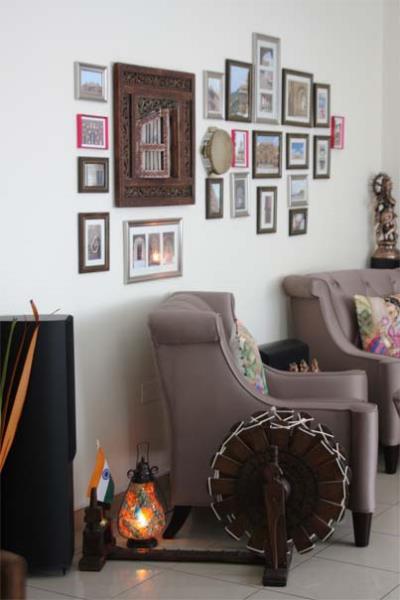
Take, for instance, Patricia Torres (coloursdekor.blogspot.com), who describes herself as an “ordinary person, a working woman, a mom, a wife, a friend.” When not at work at a multinational company in Dubai or tending to her daughters, she is busy at home “aspiring to see beauty in everything around me.” With a full-time job, she often wonders if she would have taken up design as a career if the opportunity had presented itself earlier in her life. It was a friend’s suggestion that she consider blogging about the million or so pictures she would take of things around her house that got her started. Her blog is her “design diary.” She manages to pull it off, blogging in between her day job, parenting and home-making.
As a teenager, Kamini Raghavan (saffronandsilk.blogspot.com), would spend hours arranging and re-arranging furniture, artwork, and flowers around her house, though she just started blogging about design in 2010. For most bloggers I spoke with, blogging is a relatively new experience. While some bloggers are professionally trained in design and décor, a few have successfully turned an amateur interest into a nearly full-time career. Kamini, who originally earned a degree in Economics, went back to school in the 1990s to earn a degree in interior design. She worked in the industry for nine years in the U.S. before moving back to India in 2006.
Sudha Sundareswaran (adesignenthusiast.blogspot.com), grew up helping her grandfather with his various woodworking projects, picking up carpentry skills along the way. Therefore, Sudha sees herself more as a design enthusiast than a decorator. She started her design blog more as a way to attract attention to her original blog on green/environmentally conscious living. As a result, she now juggles between three blogs—cooking, design, and green living.
Anuradha Varma (mydreamcanvas.blogspot.com) reminisces about decorating her own room as a kid, and being extremely possessive of the knick-knacks that she would randomly pick up. She started blogging in 2008 more as a way to chronicle her own experiences with design and décor. Her lifestyle blog, My Dream Canvas, evolved out of the countless hours she spent browsing through design-and-décor magazines and a desire to critique them. She blogs full-time and loves every addictive minute of it.
 Gagan (who blogs at Of Peacocks and Paisleys, http://gb73.blogspot.com/) quips that décor and design are part of her genetic makeup, since she is the daughter of an artist. She started her blog in 2010 when she realized that some of her comments on the blogs she followed were longer than the blog posts on which she was commenting.
A chance visit to any one of the blogs featured here will clue you in to the sense of camaraderie and bonhomie that prevails in the community. Bloggers regularly feature others’ blogs and posts, invite guest blogs, and organize frequent giveaways that mutually benefit each other’s blogs.
A good majority of the readership is drawn from the Indian community at large, whether from India, the U.S., the U.K. or the Middle East. Many bloggers have also tapped into the larger cosmopolitan global-design blogging community. Sudha’s blog was recently featured on apartmentherapy.com, the go-to blog for design inspirations.
Few bloggers seem overly concerned about readership. Blogging seems to provide such pure joy that many of the women I spoke to had never really considered developing their blogging into a business.